Amethyst deceiver
Laccaria amethystina
Dangerous look-alikesNearly overCan be confused with seriously poisonous species. Learn the look-alikes first.
Is amethyst deceiver in season now?
As of : Only just: amethyst deceiver is nearly over for the year in the UK. Its season runs from August to November. Today's forecast is highest in Surrey, Dumfries and Galloway and West Sussex. It can be confused with lilac fibrecap and lilac bonnet, which are poisonous: check every find with an expert before eating it.


A small, wholly violet mushroom, the cap 2-6 cm across, with thick, widely spaced violet gills and a tough fibrous stem; it fades to pale buff as it dries. Abundant in leaf litter under beech and oak, and with conifers. The poisonous lilac fibrecap has a pointed, silky cap and crowded gills that turn clay-brown rather than staying violet.
Parts gathered: cap.
Season
August to November
Taller bars are the months with most records across the UK. The south usually runs a week or two ahead of the north.
Habitat
- Found in woodland and trees.
- Grows with beech, oak, birch, pine and spruce.
- Fruits from the ground.
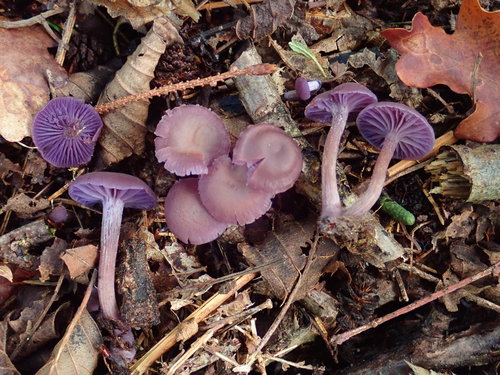
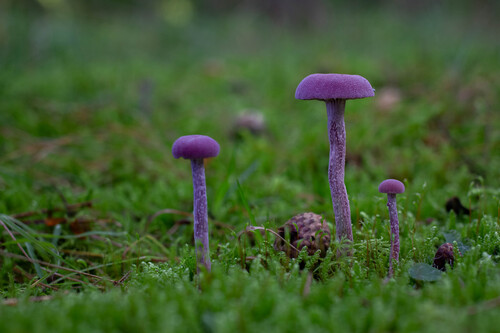
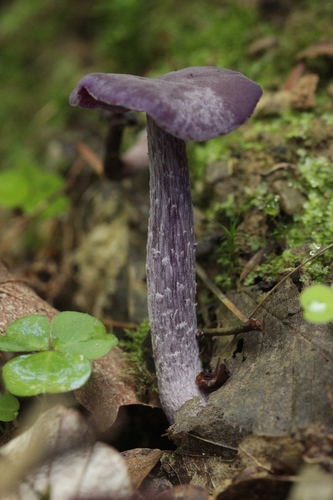
Where it is likely right now
Forecast for Wednesday 11 November. Zoom in for 5 km² detail, or open it on the full map.
Best counties today
- SurreyFair34
- Dumfries and GallowayFair32
- West SussexFair32
- HampshireSlim29
- Neath Port TalbotSlim29
- East SussexSlim29
- Rhondda Cynon TafSlim28
- CarmarthenshireSlim28
- Fermanagh and OmaghSlim28
- North LanarkshireSlim27
- Westmorland and FurnessSlim27
- CumberlandSlim26
Look-alikes: tell them apart
Check every one of these before you pick. One matching feature is not enough: they all have to match. If you cannot tell them apart with confidence, leave it.

- Thick, widely spaced and deep violet; they stay violetCrowded; pale at first, then clay-brown
- Rounded then flat, often dimpled, with no pointSilky, with a pointed centre that is often ochre
- Tough and fibrous, violet like the capPaler and more fragile
- WhiteDull brown
- FaintEarthy or mealy
Amethyst deceiverLilac fibrecapLilac bonnet
Mycena pura
Poisonous
- FaintStrongly of radish when crushed
- Thick, widely spaced and deep violetPale, whitish to pink
- Tough and fibrous; twists without snappingHollow and brittle; snaps cleanly
- Violet, fading to buffPinkish lilac, with fine lines at the edge when damp
Amethyst deceiverLilac bonnet
More field guides
A good book helps you learn what to look for. It is no substitute for checking a find with an expert. We earn a commission if you buy through these links, at no extra cost to you.
Collins Complete British Mushrooms and Toadstools
The essential photograph guide to Britain's fungi
Paul Sterry and Barry Hughes (Collins)
A photographic identification guide, useful for checking what else a find could be.
Buy on Bookshop.org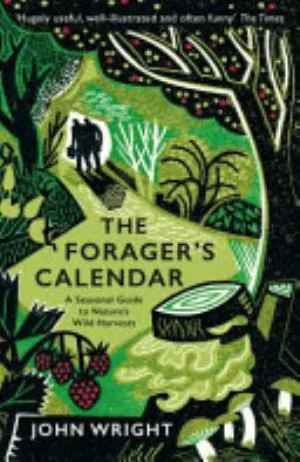
The Forager's Calendar
A seasonal guide to nature's wild harvests
John Wright (Profile Books)
A month-by-month guide to what to look for through the year in Britain.
Buy on Bookshop.orgThe law
Some sites ban or restrict fungi picking through byelaws or codes of conduct, for example Epping Forest and Forestry England's New Forest. Picking to sell always needs the landowner's permission. See the law page for the general rules.
See the overview of UK foraging law. This is not legal advice.
Questions about amethyst deceiver
- When is amethyst deceiver in season in the UK?
- Amethyst deceiver is in season in the UK from August to November, and is usually at its best in October. The south usually runs a week or two ahead of the north.
- Where does amethyst deceiver grow?
- Found in woodland and trees. Grows with beech, oak, birch, pine and spruce. Fruits from the ground.
- What can amethyst deceiver be confused with?
- Amethyst deceiver can be confused with lilac fibrecap (poisonous) and lilac bonnet (poisonous). One matching feature is never enough: check every one, and confirm every find with an expert before eating it.