Cep (penny bun)
Boletus edulis
Also called penny bun, porcini, king bolete.
Take careNearly overNeeds care with identification, preparation or how much is eaten.
Is cep (penny bun) in season now?
As of : Only just: cep (penny bun) is nearly over for the year in the UK. Its season runs from August to November. Today's forecast is highest in Stirling and Dumfries and Galloway. It can be confused with devil's bolete, which is poisonous: check every find with an expert before eating it.


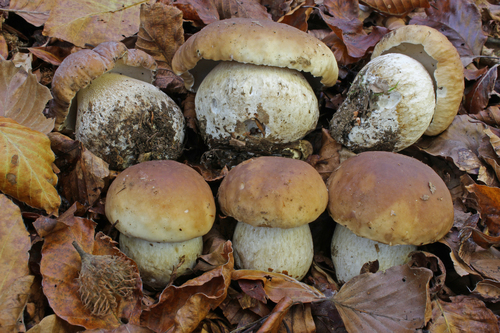
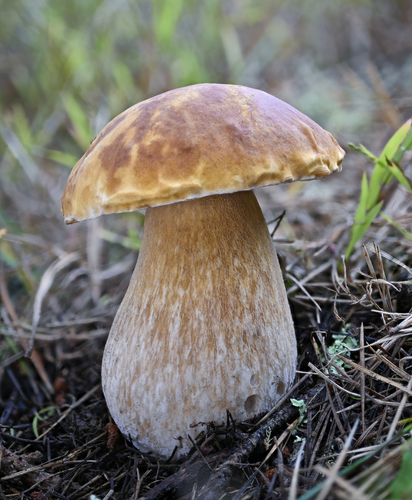
A thick-set bolete with a brown, bun-like cap 8-25 cm across, a sponge of pores that starts white and turns yellow-green, and a swollen pale stem covered in a fine white net pattern. The flesh stays white when cut. Grows with oak, beech, birch, pine and spruce, often along woodland rides and edges. The bitter bolete has pinkish pores and a dark net on the stem; avoid any bolete with red pores or flesh that turns blue quickly.
Parts gathered: cap, stem.
Season
August to November
Taller bars are the months with most records across the UK. The south usually runs a week or two ahead of the north.
Habitat
- Found in woodland and trees.
- Grows with oak, beech, birch, pine, spruce and sweet chestnut.
- Fruits from the ground.
- Prefers acid soils.

Where it is likely right now
Forecast for Wednesday 11 November. Zoom in for 5 km² detail, or open it on the full map.
Best counties today
- StirlingSlim20
- Dumfries and GallowaySlim20
- Perth and KinrossSlim19
- Westmorland and FurnessSlim19
- Neath Port TalbotSlim18
- South LanarkshireSlim18
- MoraySlim18
- AngusSlim18
- HighlandSlim18
- GwyneddSlim18
- Scottish BordersSlim18
- ConwySlim17
Look-alikes: tell them apart
Check every one of these before you pick. One matching feature is not enough: they all have to match. If you cannot tell them apart with confidence, leave it.
Devil's bolete
Rubroboletus satanas
Poisonous
- White to yellow-greenOrange to blood red
- BrownChalky white to pale grey
- Stays whiteTurns pale blue
- Widespread with many treesRare: under beech and oak on chalk and limestone in southern England
Cep (penny bun)Devil's boleteBitter bolete
Tylopilus felleus
Not for eating
- White, then yellow-greenWhite, then pink
- Fine and white, on a pale stemCoarse and dark brown
- Olive-brownPinkish
Cep (penny bun)Bitter bolete
- Swollen and pale, with a fine white net near the topSlimmer, streaked brown, with no net
- White, then yellow-green; they do not bruise bluePale yellow; they bruise blue-green when pressed
- Like a crusty bun, 8-25 cm acrossChestnut brown, 5-15 cm, slightly sticky when wet
Cep (penny bun)Bay bolete
More field guides
A good book helps you learn what to look for. It is no substitute for checking a find with an expert. We earn a commission if you buy through these links, at no extra cost to you.
Collins Complete British Mushrooms and Toadstools
The essential photograph guide to Britain's fungi
Paul Sterry and Barry Hughes (Collins)
A photographic identification guide, useful for checking what else a find could be.
Buy on Bookshop.org
The Forager's Calendar
A seasonal guide to nature's wild harvests
John Wright (Profile Books)
A month-by-month guide to what to look for through the year in Britain.
Buy on Bookshop.orgThe law
Some sites ban or restrict fungi picking through byelaws or codes of conduct, for example Epping Forest and Forestry England's New Forest. Picking to sell always needs the landowner's permission. See the law page for the general rules.
See the overview of UK foraging law. This is not legal advice.
Questions about cep (penny bun)
- When is cep (penny bun) in season in the UK?
- Cep (penny bun) is in season in the UK from August to November, and is usually at its best in September and October. The south usually runs a week or two ahead of the north.
- Where does cep (penny bun) grow?
- Found in woodland and trees. Grows with oak, beech, birch, pine, spruce and sweet chestnut. Fruits from the ground. Prefers acid soils.
- What can cep (penny bun) be confused with?
- Cep (penny bun) can be confused with devil's bolete (poisonous), bitter bolete and bay bolete. One matching feature is never enough: check every one, and confirm every find with an expert before eating it.