Giant puffball
Calvatia gigantea
Take careNearly overNeeds care with identification, preparation or how much is eaten.
Is giant puffball in season now?
As of : Only just: giant puffball is nearly over for the year in the UK. Its season runs from July to October. It can be confused with common earthball, death cap and destroying angel, which are poisonous: check every find with an expert before eating it.

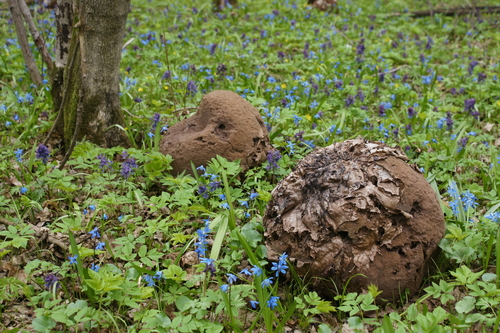
A smooth white ball with no stem, typically 20-50 cm across, found in nutrient-rich pasture, hedge bottoms, field edges, nettle beds and gardens. Only young specimens that are pure white and uniform all the way through are used; any yellowing means the spores are forming. Small "puffballs" must be cut in half: an earthball is dark inside, and the outline of a cap and gills means the egg stage of a deadly Amanita.
Parts gathered: young fruiting body.
Season
July to October
Taller bars are the months with most records across the UK. The south usually runs a week or two ahead of the north.
Habitat
- Found in grassland and pasture and farmland and field edges.
- Fruits from the ground.
- Soil pH roughly 5.5 to 8.
- Mostly below about 350 m.

Where it is likely right now
Forecast for Wednesday 11 November. Zoom in for 5 km² detail, or open it on the full map.
Best counties today
- HertfordshireSlim18
- West BerkshireSlim18
- SuffolkSlim17
- NorfolkSlim16
- East Riding of YorkshireSlim16
- North LincolnshireSlim16
- EssexSlim16
- CambridgeshireSlim16
- Greater LondonSlim16
- BedfordSlim16
- LincolnshireSlim16
- Central BedfordshireSlim15
Look-alikes: tell them apart
Check every one of these before you pick. One matching feature is not enough: they all have to match. If you cannot tell them apart with confidence, leave it.

- Smooth, white and soft, like kid leatherThick, tough, yellowish-brown, warty or scaly
- Pure white and even all the way throughPurplish black inside from an early stage, marbled with white
- Usually 20-50 cm across4-10 cm across
- Rich pasture, hedge bottoms, nettle bedsAcid soil under birch and oak, and on heaths
Giant puffballCommon earthball
- Solid, even white flesh with no pattern in itThe outline of a small mushroom inside: cap, gills and stem
- Football-sized when readyThe 'egg' is the size of a hen's egg
- Open grassland and hedge bottomsUnder oak and beech
Giant puffballDeath cap
- Solid, even white flesh with no pattern in itThe outline of a small mushroom inside: cap, gills and stem
- Football-sized when readyThe 'egg' is the size of a hen's egg
- Open grassland and hedge bottomsDamp, mossy woodland with birch and beech
Giant puffballDestroying angel
More field guides
A good book helps you learn what to look for. It is no substitute for checking a find with an expert. We earn a commission if you buy through these links, at no extra cost to you.
Collins Complete British Mushrooms and Toadstools
The essential photograph guide to Britain's fungi
Paul Sterry and Barry Hughes (Collins)
A photographic identification guide, useful for checking what else a find could be.
Buy on Bookshop.org
The Forager's Calendar
A seasonal guide to nature's wild harvests
John Wright (Profile Books)
A month-by-month guide to what to look for through the year in Britain.
Buy on Bookshop.orgThe law
Some sites ban or restrict fungi picking through byelaws or codes of conduct, for example Epping Forest and Forestry England's New Forest. Picking to sell always needs the landowner's permission. See the law page for the general rules.
See the overview of UK foraging law. This is not legal advice.
Questions about giant puffball
- When is giant puffball in season in the UK?
- Giant puffball is in season in the UK from July to October, and is usually at its best in September and October. The south usually runs a week or two ahead of the north.
- Where does giant puffball grow?
- Found in grassland and pasture and farmland and field edges. Fruits from the ground. Soil pH roughly 5.5 to 8. Mostly below about 350 m.
- What can giant puffball be confused with?
- Giant puffball can be confused with common earthball (poisonous), death cap (poisonous) and destroying angel (poisonous). One matching feature is never enough: check every one, and confirm every find with an expert before eating it.