Horse mushroom
Agaricus arvensis
Dangerous look-alikesNearly overCan be confused with seriously poisonous species. Learn the look-alikes first.
Is horse mushroom in season now?
As of : Only just: horse mushroom is nearly over for the year in the UK. Its season runs from July to November. Today's forecast is highest in Isle of Anglesey, Orkney Islands and Antrim and Newtownabbey. It can be confused with yellow stainer, destroying angel and death cap, which are poisonous: check every find with an expert before eating it.


A large, creamy-white mushroom, the cap 10-25 cm across and slowly bruising dull yellow, with a big hanging ring that has a cogwheel pattern on its underside. The gills go from greyish-pink to dark brown and it smells of aniseed. Found in old pasture, parkland and verges, often in rings. The yellow stainer flushes bright chrome yellow in the stem base and smells unpleasant; deadly Amanitas keep white gills and have a volva.
Parts gathered: cap, stem.
Season
July to November
Taller bars are the months with most records across the UK. The south usually runs a week or two ahead of the north.
Habitat
- Found in grassland and pasture.
- Fruits from the ground.
- Soil pH roughly 5.5 to 8.
- Mostly below about 400 m.

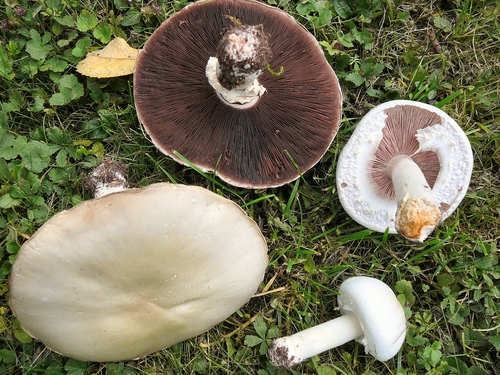
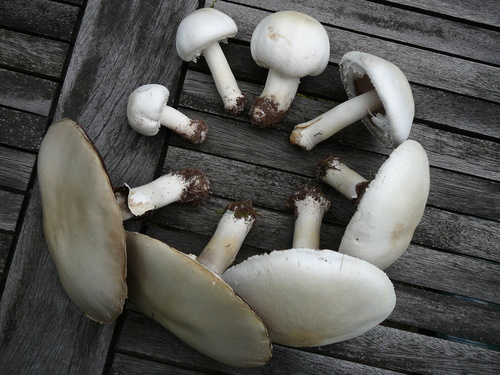
Where it is likely right now
Forecast for Wednesday 11 November. Zoom in for 5 km² detail, or open it on the full map.
Best counties today
- Isle of AngleseyFair40
- Orkney IslandsFair40
- Antrim and NewtownabbeyFair36
- Isle of WightFair34
- Mid and East AntrimFair34
- Causeway Coast and GlensFair33
- Armagh City, Banbridge and CraigavonFair31
- Lisburn and CastlereaghFair30
- Ards and North DownSlim29
- Mid UlsterSlim27
- PembrokeshireSlim26
- DorsetSlim26
Look-alikes: tell them apart
Check every one of these before you pick. One matching feature is not enough: they all have to match. If you cannot tell them apart with confidence, leave it.

- The cap bruises dull yellow slowly; the stem base does not flush yellow when cutThe flesh in the very base of the stem turns bright chrome yellow at once
- AniseedInk, carbolic or disinfectant
- Big and hanging, with a cogwheel pattern underneathLarge, with a thick double edge and no cogwheel
Horse mushroomYellow stainer
- Greyish pink, then dark brownPure white
- No bagA large white bag (volva)
- Dark brownWhite
- Old pasture, parkland and vergesDamp woodland with birch and beech
Horse mushroomDestroying angel
- Greyish pink, then dark brownWhite, and they stay white
- No bagSwollen and sitting in a white bag (volva)
- Dark brownWhite
- AniseedSweetish and sickly, stronger with age
Horse mushroomDeath cap
More field guides
A good book helps you learn what to look for. It is no substitute for checking a find with an expert. We earn a commission if you buy through these links, at no extra cost to you.
Collins Complete British Mushrooms and Toadstools
The essential photograph guide to Britain's fungi
Paul Sterry and Barry Hughes (Collins)
A photographic identification guide, useful for checking what else a find could be.
Buy on Bookshop.org
The Forager's Calendar
A seasonal guide to nature's wild harvests
John Wright (Profile Books)
A month-by-month guide to what to look for through the year in Britain.
Buy on Bookshop.orgThe law
Some sites ban or restrict fungi picking through byelaws or codes of conduct, for example Epping Forest and Forestry England's New Forest. Picking to sell always needs the landowner's permission. See the law page for the general rules.
See the overview of UK foraging law. This is not legal advice.
Questions about horse mushroom
- When is horse mushroom in season in the UK?
- Horse mushroom is in season in the UK from July to November, and is usually at its best in September and October. The south usually runs a week or two ahead of the north.
- Where does horse mushroom grow?
- Found in grassland and pasture. Fruits from the ground. Soil pH roughly 5.5 to 8. Mostly below about 400 m.
- What can horse mushroom be confused with?
- Horse mushroom can be confused with yellow stainer (poisonous), destroying angel (poisonous) and death cap (poisonous). One matching feature is never enough: check every one, and confirm every find with an expert before eating it.