Sloe
Prunus spinosa
Also called blackthorn.
Take careAt its best nowNeeds care with identification, preparation or how much is eaten.
Is sloe in season now?
As of : Yes: sloe is in season in the UK and at its best. Its season runs from September to December. Today's forecast is highest in Greater London, Hertfordshire and West Berkshire. It can be confused with deadly nightshade and buckthorn, which are poisonous: check every find with an expert before eating it.

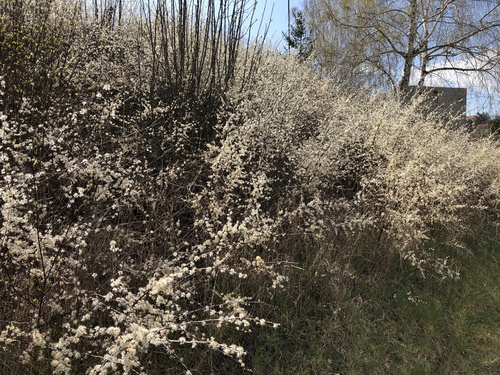
The fruit of the blackthorn, a dense, dark-barked, viciously thorny hedgerow shrub that flowers white on bare twigs in March. Sloes are round, 1-1.5 cm across, blue-black with a pale waxy bloom, with green flesh around a single stone, and are mouth-dryingly sour. Blackthorn's long thorns and small oval leaves separate it from buckthorn, whose black berries are purgative, and from deadly nightshade, which is a soft, thornless plant with glossy berries sitting on a green star.
Parts gathered: fruit.
Season
September to December
Taller bars are the months with most records across the UK. The south usually runs a week or two ahead of the north.
Habitat
- Found in scrub, hedges and heath, woodland and trees, grassland and pasture and farmland and field edges.
- Soil pH roughly 5.5 to 8.5.
- Mostly below about 400 m.

Where it is likely right now
Forecast for Wednesday 11 November. Zoom in for 5 km² detail, or open it on the full map.
Best counties today
- Greater LondonGood54
- HertfordshireGood51
- West BerkshireFair49
- BuckinghamshireFair46
- EssexFair46
- WiltshireFair43
- OxfordshireFair42
- SurreyFair41
- West NorthamptonshireFair40
- HampshireFair40
- North NorthamptonshireFair40
- Central BedfordshireFair39
Look-alikes: tell them apart
Check every one of these before you pick. One matching feature is not enough: they all have to match. If you cannot tell them apart with confidence, leave it.

- A dense, woody, thorny shrub with dark barkA soft, green-stemmed, bushy plant with no thorns
- Blue-black with a pale waxy bloom; one hard stoneShiny jet black with no bloom; many small seeds; sits on a green five-pointed star
- Small ovals 2-4 cm long, finely toothedLarge, soft, pointed ovals up to 20 cm long, with no teeth
SloeDeadly nightshadeBuckthorn
Rhamnus cathartica
Poisonous
- Has a waxy bloom and a single stoneShiny black with no bloom and two to four seeds, in clusters
- Set singly along the twigIn near-opposite pairs, with veins that curve towards the tip
- Long thorns all along the branchesA single thorn at the tip of some twigs
SloeBuckthorn
More field guides
A good book helps you learn what to look for. It is no substitute for checking a find with an expert. We earn a commission if you buy through these links, at no extra cost to you.

Food for Free
50th anniversary edition
Richard Mabey (William Collins)
The classic guide to Britain's wild food, first published in 1972.
Buy on Bookshop.org
The Forager's Calendar
A seasonal guide to nature's wild harvests
John Wright (Profile Books)
A month-by-month guide to what to look for through the year in Britain.
Buy on Bookshop.orgQuestions about sloe
- When is sloe in season in the UK?
- Sloe is in season in the UK from September to December, and is usually at its best in September and October. The south usually runs a week or two ahead of the north.
- Where does sloe grow?
- Found in scrub, hedges and heath, woodland and trees, grassland and pasture and farmland and field edges. Soil pH roughly 5.5 to 8.5. Mostly below about 400 m.
- What can sloe be confused with?
- Sloe can be confused with deadly nightshade (poisonous) and buckthorn (poisonous). One matching feature is never enough: check every one, and confirm every find with an expert before eating it.