Panther cap
Amanita pantherina
PoisonousNearly goneShown so you can recognise it and leave it alone. Do not eat it.
Is panther cap about now?
As of : Panther cap is poisonous and must not be eaten. It is about in the UK now. Its season runs from July to November. Today's forecast is highest in East Sussex, West Sussex and Hampshire. It is described here so that it can be recognised and ruled out.


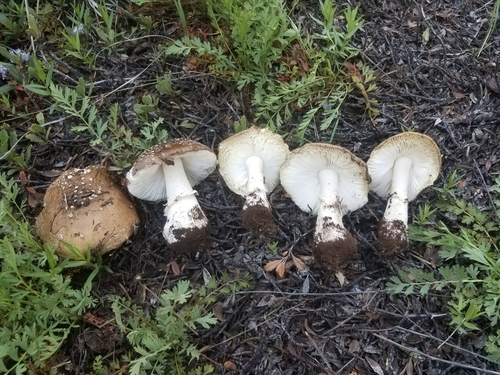
A brown-capped Amanita, 6-11 cm across, dotted with pure white warts, with white gills, a ring that has no grooves on its upper side, and a bulbous base topped by a distinct gutter-like rim. Uncommon, in broadleaved woodland, especially with beech and oak. It causes severe poisoning affecting the nervous system. The blusher looks similar but has greyish warts and flesh that slowly turns pink where damaged.
When it is about
July to November
Taller bars are the months with most records across the UK. The south usually runs a week or two ahead of the north.
Habitat
- Found in woodland and trees.
- Grows with beech and oak.
- Fruits from the ground.
- Mostly below about 350 m.

Where it is likely right now
Forecast for Wednesday 11 November. Zoom in for 5 km² detail, or open it on the full map.
Best counties today
- East SussexFair32
- West SussexFair32
- HampshireFair31
- KentSlim29
- SurreySlim28
- WiltshireSlim26
- Lisburn and CastlereaghSlim26
- DorsetSlim25
- Antrim and NewtownabbeySlim24
- Armagh City, Banbridge and CraigavonSlim23
- West BerkshireSlim23
- CornwallSlim23
What it is confused with
These are the species it is mistaken for, and the features that separate them.
Blusher
Amanita rubescens
Can make you ill
- Pure whiteGreyish or dirty pink
- Stays whiteSlowly turns pink, especially where insects have eaten it
- Smooth on its upper sideMarked with fine grooves on its upper side
- A bulb with a distinct gutter-like rimA bulb with no rim
Panther capBlusher
- Pure white warts that rub off a smooth brown capBrown scales that are part of the skin, around a dark central bump
- White, with no bandsTall and slender, banded with brown snakeskin markings
- Thin, skirt-like and fixedThick, double-edged, and slides up and down the stem
- A bulb with a distinct gutter-like rim round the topA plain bulb with no rim or bag
- Cap 6-11 cmCap 10-30 cm
Panther capParasol
Questions about panther cap
- When is panther cap about in the UK?
- Panther cap appears in the UK from July to November, and is most often seen in October.
- Where does panther cap grow?
- Found in woodland and trees. Grows with beech and oak. Fruits from the ground. Mostly below about 350 m.
- What can panther cap be confused with?
- Panther cap can be confused with blusher and parasol. Learn the differences so that you can rule it out.