Parasol
Macrolepiota procera
Dangerous look-alikesNearly overCan be confused with seriously poisonous species. Learn the look-alikes first.
Is parasol in season now?
As of : Only just: parasol is nearly over for the year in the UK. Its season runs from July to November. Today's forecast is highest in Isle of Wight, Swansea and Cornwall. It can be confused with panther cap and dapperlings, which are poisonous: check every find with an expert before eating it.


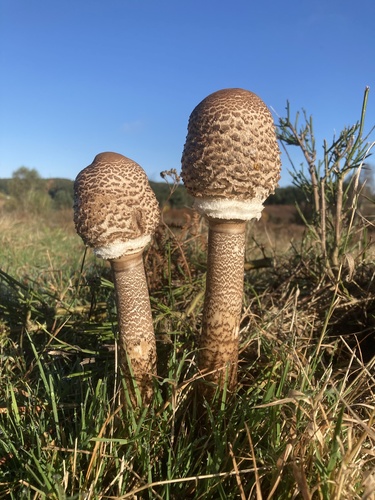
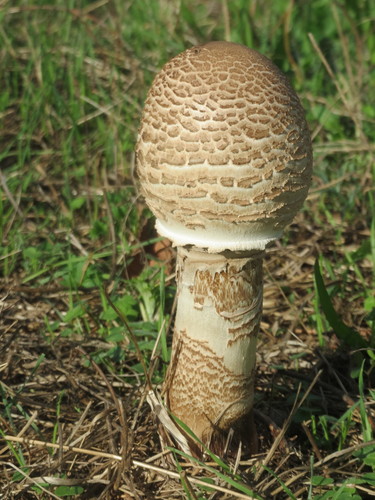
A tall mushroom with a cap 10-30 cm across covered in brown scales around a darker central bump, a movable double ring, and a slender stem banded with brown snakeskin markings. Found in open grassland, cliff-top turf, dunes, verges and woodland glades. Size matters: small look-alike dapperlings (Lepiota), with caps under 10 cm, include deadly species. The shaggy parasol reddens when cut and makes some people ill. The panther cap has white warts rather than brown scales, and a bulbous base with a rim.
Parts gathered: cap.
Season
July to November
Taller bars are the months with most records across the UK. The south usually runs a week or two ahead of the north.
Habitat
- Found in grassland and pasture and woodland and trees.
- Fruits from the ground.
- Mostly below about 350 m.
Where it is likely right now
Forecast for Wednesday 11 November. Zoom in for 5 km² detail, or open it on the full map.
Best counties today
- Isle of WightFair31
- SwanseaSlim25
- CornwallSlim23
- Greater LondonSlim23
- SurreySlim23
- HertfordshireSlim22
- West BerkshireSlim22
- MonmouthshireSlim21
- East SussexSlim21
- KentSlim21
- EssexSlim21
- West SussexSlim20
Look-alikes: tell them apart
Check every one of these before you pick. One matching feature is not enough: they all have to match. If you cannot tell them apart with confidence, leave it.

- Brown scales that are part of the skin, around a dark central bumpPure white warts that rub off a smooth brown cap
- Tall and slender, banded with brown snakeskin markingsWhite, with no bands
- Thick, double-edged, and slides up and down the stemThin, skirt-like and fixed
- A plain bulb with no rim or bagA bulb with a distinct gutter-like rim round the top
- Cap 10-30 cmCap 6-11 cm
ParasolPanther capDapperlings
Lepiota species
Deadly
- Cap 10-30 cm when open, on a stem 15-40 cm tallThe deadly ones are small: caps mostly 2-7 cm
- Thick, double-edged and movableFlimsy, or just a ragged zone; it does not slide
- Brown snakeskin bands on a pale groundNo snakeskin bands; often pinkish or scaly towards the base
ParasolDapperlingsLeave any 'parasol' whose open cap is less than 12 cm across.
Shaggy parasol
Chlorophyllum rhacodes
Can make you ill
- Stays white or turns faintly pinkTurns saffron orange, then red-brown, most strongly in the stem
- Snakeskin bandsPlain and smooth, with a big bulb at the base
- Flat brown scales on a pale groundCoarse, shaggy, upturned scales
- Open grasslandWoods, hedges, gardens and compost
ParasolShaggy parasol
More field guides
A good book helps you learn what to look for. It is no substitute for checking a find with an expert. We earn a commission if you buy through these links, at no extra cost to you.
Collins Complete British Mushrooms and Toadstools
The essential photograph guide to Britain's fungi
Paul Sterry and Barry Hughes (Collins)
A photographic identification guide, useful for checking what else a find could be.
Buy on Bookshop.org
The Forager's Calendar
A seasonal guide to nature's wild harvests
John Wright (Profile Books)
A month-by-month guide to what to look for through the year in Britain.
Buy on Bookshop.orgThe law
Some sites ban or restrict fungi picking through byelaws or codes of conduct, for example Epping Forest and Forestry England's New Forest. Picking to sell always needs the landowner's permission. See the law page for the general rules.
See the overview of UK foraging law. This is not legal advice.
Questions about parasol
- When is parasol in season in the UK?
- Parasol is in season in the UK from July to November, and is usually at its best in October. The south usually runs a week or two ahead of the north.
- Where does parasol grow?
- Found in grassland and pasture and woodland and trees. Fruits from the ground. Mostly below about 350 m.
- What can parasol be confused with?
- Parasol can be confused with panther cap (poisonous), dapperlings (deadly) and shaggy parasol. One matching feature is never enough: check every one, and confirm every find with an expert before eating it.