Trumpet chanterelle
Craterellus tubaeformis
Also called winter chanterelle, yellowlegs.
Dangerous look-alikesNearly overCan be confused with seriously poisonous species. Learn the look-alikes first.
Is trumpet chanterelle in season now?
As of : Only just: trumpet chanterelle is nearly over for the year in the UK. Its season runs from September to December. Today's forecast is highest in Stirling, Dumfries and Galloway and Argyll and Bute. It can be confused with deadly webcap, which is poisonous: check every find with an expert before eating it.


A small brown, funnel-shaped cap 2-6 cm across with a hollow, yellow stem and greyish, forked, vein-like ridges underneath. Grows in large troops in moss under conifers and beech on acid soils, well into early winter. The dull cap makes it hard to spot until the yellow stems give it away. The deadly webcap grows in the same mossy woods and can end up in the basket with it: it has true rusty gills and a solid, banded stem. The jellybaby, a small slimy fungus of the same places, has a rounded head with no ridges.
Parts gathered: cap, stem.
Season
September to December
Taller bars are the months with most records across the UK. The south usually runs a week or two ahead of the north.
Habitat
- Found in woodland and trees.
- Grows with spruce, pine, beech and birch.
- Fruits from the ground.
- Commonest on sandstone, granite and other acid rocks, hard, old metamorphic rocks and mudstone and shale.
- Prefers acid soils.
Where it is likely right now
Forecast for Wednesday 11 November. Zoom in for 5 km² detail, or open it on the full map.
Best counties today
- StirlingFair49
- Dumfries and GallowayFair46
- Argyll and ButeFair45
- HighlandFair43
- Perth and KinrossFair37
- Fermanagh and OmaghFair35
- North AyrshireFair34
- South AyrshireFair32
- East AyrshireFair32
- MorayFair31
- Derry City and StrabaneFair30
- South LanarkshireSlim27
Look-alikes: tell them apart
Check every one of these before you pick. One matching feature is not enough: they all have to match. If you cannot tell them apart with confidence, leave it.
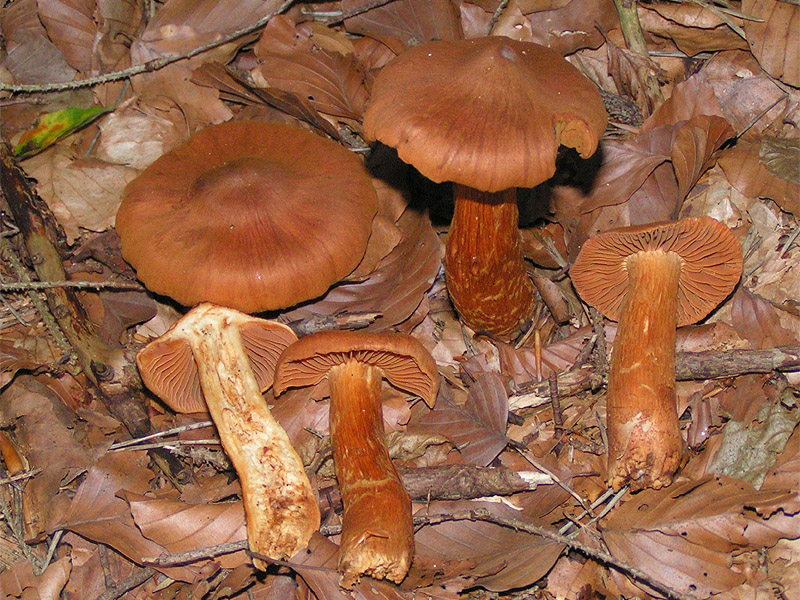
- Shallow, forked, greyish ridges running down the stemTrue gills: thick, widely spaced and rusty brown
- Hollow like a straw, yellow and smoothSolid and tawny, with yellowish snakeskin bands
- A thin funnel, usually with a hole in the middle leading down the stemPointed or domed and finely scaly; never a funnel
- White to creamRusty brown
Trumpet chanterelleDeadly webcapThe two grow side by side in the same mossy woods, so check every stem as you pick.

- Brown cap, yellow stem, greyish ridgesEgg-yolk yellow all over
- Thin and hollowThick and solid
- September into early winterJuly to November
Trumpet chanterelleChanterelleJellybaby
Leotia lubrica
Not for eating
- A thin funnel with ridges underneathA rounded, lumpy, olive-yellow knob with no ridges
- Thin and pliableRubbery and slimy
Trumpet chanterelleJellybaby
More field guides
A good book helps you learn what to look for. It is no substitute for checking a find with an expert. We earn a commission if you buy through these links, at no extra cost to you.
Collins Complete British Mushrooms and Toadstools
The essential photograph guide to Britain's fungi
Paul Sterry and Barry Hughes (Collins)
A photographic identification guide, useful for checking what else a find could be.
Buy on Bookshop.org
The Forager's Calendar
A seasonal guide to nature's wild harvests
John Wright (Profile Books)
A month-by-month guide to what to look for through the year in Britain.
Buy on Bookshop.orgThe law
Some sites ban or restrict fungi picking through byelaws or codes of conduct, for example Epping Forest and Forestry England's New Forest. Picking to sell always needs the landowner's permission. See the law page for the general rules.
See the overview of UK foraging law. This is not legal advice.
Questions about trumpet chanterelle
- When is trumpet chanterelle in season in the UK?
- Trumpet chanterelle is in season in the UK from September to December, and is usually at its best in September and October. The south usually runs a week or two ahead of the north.
- Where does trumpet chanterelle grow?
- Found in woodland and trees. Grows with spruce, pine, beech and birch. Fruits from the ground. Commonest on sandstone, granite and other acid rocks, hard, old metamorphic rocks and mudstone and shale. Prefers acid soils.
- What can trumpet chanterelle be confused with?
- Trumpet chanterelle can be confused with deadly webcap (poisonous), chanterelle and jellybaby. One matching feature is never enough: check every one, and confirm every find with an expert before eating it.